
So you've volunteered to coach youth basketball, where "traveling" isn't about vacation plans, "double dribble" sounds like a ice cream flavor, and half your team thinks the three-point line is decorative gymnasium art. Welcome to the controlled chaos of teaching kids to dribble, shoot, and occasionally pass to teammates instead of launching half-court prayers every possession!
Youth basketball coaching combines teaching fundamental skills with managing varying attention spans, competitive parents who peaked in high school, and the eternal challenge of explaining why you can't just run with the ball like in football. According to USA Basketball's Youth Development Guidelines, over 4 million children participate in organized basketball annually, making it one of America's most popular youth sports.
Basketball Coach Reality Check! Your 8-year-old point guard will dribble off their foot at least 47 times per game, someone will shoot at the wrong basket after halftime, and at least one player will celebrate a made free throw like they just won the NBA Finals. This is the beautiful chaos of youth basketball!
Understanding Age-Appropriate Basketball Development
Youth basketball players develop at wildly different rates, creating teams where one kid performs crossover dribbles while their teammate still double-dribbles accidentally every possession. Understanding developmental stages helps set realistic expectations and prevents you from attempting triangle offense with kids who can't make triangles with their fingers.
Ages 5-7: Organized Chaos Division
Mini basketball players primarily need fun, basic coordination, and frequent reminders that defense doesn't mean hugging opponents. Focus on dribbling without looking at the ball (good luck), shooting with somewhat proper form (basketball goes up, hopefully toward basket), and understanding that teammates wear the same color jersey.
Games resemble rugby with occasional dribbling. Five players chase one ball like puppies after a tennis ball. Celebrate when someone passes intentionally, even if it's to the referee. Success means everyone wants to come back next week.
Ages 8-10: Fundamental Foundations
Players begin grasping actual basketball concepts like "space" and "cutting" though execution remains hilariously unpredictable. They understand positions exist but still cluster around the ball like moths to a porch light. Some discover they can shoot from distance, though "distance" and "accuracy" rarely cooperate.
This age loves competition but needs careful emotional management. The player who cries over missed layups might drain clutch free throws five minutes later. Keep perspective - they're still learning that banks shots aren't about money.
Ages 11-14: Skill Development Zone
Pre-teens can handle complex concepts, structured plays, and constructive criticism (sometimes). They're developing real basketball skills while navigating growth spurts that temporarily destroy coordination. The kid who was your center last season might be your point guard now.
Competition intensifies as players begin understanding winning and losing matter. Balance competitive development with ensuring everyone improves and enjoys the experience. Remember: most won't play professionally, but all can learn valuable life lessons through basketball.
Essential Basketball Practice Drills
Great basketball drills combine skill development with engagement, because bored players become human pinballs bouncing off gym walls. Mix competitive elements with skill building to maintain energy and enthusiasm throughout practice.
Dribbling Drills That Don't Bore
Dribble Tag Mayhem
Setup: Everyone has a ball, designate 2-3 taggers
How it works: Players dribble continuously while avoiding taggers (also dribbling). Tagged players do 5 jumping jacks then continue. Switch taggers every 2 minutes.
Why it works: Develops dribbling under pressure, spatial awareness, and conditioning while being too fun to feel like work.
Red Light/Green Light Handles
Setup: Players spread across baseline with balls
How it works: Green light = dribble forward, Red light = stationary dribbling, Yellow light = dribble backward. Call out different dribble moves (crossover, between legs, behind back) during lights.
Why it works: Teaches control, different speeds, and various dribble moves while maintaining engagement through game format.
Shooting Drills for Every Level
Around the World Race
Setup: Mark 5-7 spots around the key
How it works: Players shoot from each spot, moving to next after making shot. First to complete all spots wins. Add rule variations: must make 2 from each spot, or go backward after miss.
Why it works: Practices shooting from multiple angles while adding competitive element that maintains focus.
Lightning Elimination
Setup: Two balls, players in single line at free throw line
How it works: First two players shoot - if second player makes before first, first player is eliminated. Fast-paced with constant pressure.
Why it works: Develops shooting under pressure and quick release while everyone stays engaged watching.
Passing and Team Drills
Monkey in the Middle Plus
Setup: Groups of 4-5, one defender in middle
How it works: Passers must complete 10 passes without defender touching ball. Add challenges: no passing to same person twice, must fake before passing.
Why it works: Improves passing decisions, movement without ball, and defensive positioning.
3-on-2, 2-on-1 Continuous
Setup: Three offensive players vs two defenders
How it works: After score or stop, two defenders become offense going other way against one defender. Continuous transition practice.
Why it works: Teaches fast break offense, transition defense, and decision-making in advantage situations.
Drill Reality: Perfect execution isn't the goal - engagement and improvement are. If a drill turns into chaos but everyone's laughing and trying, you're winning. Sometimes the best practices are the imperfect ones where everyone learns something!
Planning Effective Basketball Practices
Structure practices to maintain energy while building skills progressively. Kids need variety, competition, and water breaks before someone dramatically collapses claiming dehydration after three minutes of light jogging.
90-Minute Practice Blueprint
0-10 minutes: Dynamic warmup and free shooting (chaos with purpose)
10-25 minutes: Fundamental skill stations (dribbling, passing, footwork)
25-40 minutes: Team drill or competitive shooting game
40-55 minutes: Offensive concepts (plays, spacing, cutting)
55-70 minutes: Defensive concepts (stance, help, rebounding)
70-85 minutes: Controlled scrimmage with specific focus
85-90 minutes: Cool down and team meeting
Station Work for Skill Development
Rotate players through 3-4 stations every 8-10 minutes to maintain focus and energy. Station examples: ballhandling circuit, shooting form practice, defensive slides, passing accuracy challenges. Small groups allow more repetitions and individual attention.
Assign parent volunteers or assistant coaches to run stations, providing clear instructions and demonstrations. This multiplies your coaching effectiveness while keeping all players actively engaged rather than standing in long lines.
Game Day Coaching Strategies
Youth basketball games test your ability to remain calm while watching your carefully practiced plays dissolve into playground chaos. Success involves managing substitutions, maintaining positive energy, and occasionally preventing parents from offering "helpful" coaching advice from the stands.
Substitution Patterns and Playing Time
Create substitution charts ensuring equal playing time for younger ages (5-10) and fair opportunities for older groups. Nothing destroys team chemistry faster than parents timing playing minutes with stopwatch precision. Post your substitution plan to avoid confusion and conflicts.
For developmental leagues, implement position rotation so everyone learns different skills. Your shortest player deserves post experience, and your center should understand point guard responsibilities. Long-term development trumps short-term wins.
Timeout Management for Youth Basketball
- Keep it simple: Maximum two points per timeout
- Stay positive: Start with what's working before corrections
- Be specific: "Box out number 23" not "rebound better"
- Include everyone: Make eye contact with bench players too
- End strong: Team cheer brings energy back to court
Simple Offensive Systems
Youth teams need structure without complexity. Basic motion offense with rules like "pass and cut" or "pass and screen away" creates movement without requiring memorization of complex plays. Teach concepts rather than rigid patterns.
Emphasize spacing (arm's length apart), ball movement (make the defense work), and shot selection (no half-court heaves unless time expires). These principles create better basketball habits than running set plays that collapse under game pressure.
Defensive Fundamentals
Start with man-to-man defense to teach individual responsibility and positioning. Zone defenses might win more games at young ages but delay individual defensive development. Teach help defense concepts gradually as players understand their primary assignments.
Focus on effort indicators: defensive stance, active hands, communication, and hustle to loose balls. Celebrate defensive stops as enthusiastically as made baskets. Defense might not be glamorous, but it wins games and builds team identity.
Managing Parents and Building Team Culture
Basketball parents range from former players offering constant advice to newcomers googling "what is a pick and roll" during games. Managing expectations while building positive team culture requires communication, boundaries, and occasional diplomatic immunity.
Pre-Season Parent Meeting Essentials
Hold mandatory parent meeting covering your coaching philosophy, playing time approach, and team rules. Explain that youth basketball develops life skills beyond jump shots: teamwork, perseverance, handling adversity, and time management.
Establish communication protocols. The 24-hour rule prevents emotional post-game confrontations. Create roles for parent involvement: team manager, snack coordinator, scorebook keeper. Engaged parents become allies rather than critics.
Parent Do's
Cheer for all players, emphasize effort over outcomes, respect referees (even bad ones), support coach decisions, model good sportsmanship always.
Parent Don'ts
Coach from stands, criticize players (including their own), confront referees, undermine coach authority, focus solely on winning.
Building Unity
Team dinners, group volunteer projects, sibling inclusion events, celebrating achievements beyond basketball, creating lasting friendships.
Developing Individual Players
Every player brings unique abilities, challenges, and potential. Your role involves identifying strengths while addressing weaknesses through patient instruction and appropriate challenges that push without overwhelming.
Skill Assessment and Goal Setting
Early season evaluation helps identify individual development needs. Create simple skill checklists covering dribbling, shooting, passing, and defense. Work with players to set achievable goals - "make 5 of 10 free throws" rather than "become Steph Curry."
Document progress throughout the season. Kids love seeing improvement tracked tangibly. Simple charts showing made free throws, completed passes, or defensive stops provide motivation and evidence of growth beyond wins and losses.
Building Confidence in Struggling Players
Every team has players who struggle with confidence. Create special roles leveraging their strengths - make the hustler your defensive captain, the encouraging teammate your spirit leader. Success breeds confidence more than empty praise.
Provide extra instruction before or after practice for struggling players. Small improvements in fundamental skills dramatically impact confidence. The player who couldn't dribble in November might become your ballhandler by February with patient coaching.
Motivational Awards and Recognition Strategies
Recognition fuels improvement in youth basketball. Strategic awards throughout the season build confidence, encourage effort, and create positive associations with hard work that extend beyond the court.
Weekly Practice Recognition
Implement "Practice Player of the Week" awards for different categories: Defensive Stopper, Hustle Hero, Most Improved, Team Builder. Rotate categories so different skills get recognized. Post winners' names on a gym bulletin board or team website.
Game balls after each match go to standout performers - not always the high scorer. Recognize the player who set great screens, took charges, or encouraged teammates during a tough loss. Let the recipient keep the ball for the week with their achievement written on it in marker.
Building Long-Term Motivation
Create achievement levels players work toward all season: Bronze (master basic skills), Silver (consistent performance), Gold (leadership and advanced skills). Visual progress tracking with sticker charts or certificates maintains motivation through difficult stretches.
Monthly recognition ceremonies during practice build anticipation. Award categories like "Mr./Ms. Fundamentals," "Defensive Player of the Month," or "Best Teammate." These don't need expensive trophies - printed certificates, team applause, and coach recognition create meaningful moments.
End-of-Season Celebration Ideas
Season-ending celebrations should recognize every player's contribution and growth. Move beyond generic participation trophies to meaningful recognition that acknowledges individual improvement and team achievements.
Creative Award Categories
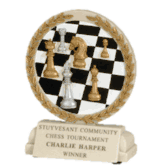
Design awards celebrating diverse contributions: Most Improved, Best Defender, Hustle Award, Team Spirit, Best Passer, Clutch Performer, Practice Player. Include humorous awards: Best Celebration Dance, Most Creative Shot Attempt, Snack MVP. These personalized recognitions create lasting memories.
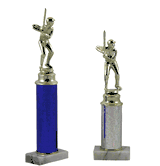
When players are ready for an end-of-season celebration, point families and league organizers to your main basketball awards page for trophies, medals, and recognition ideas.Growing as a Youth Basketball Coach
Your first season will include mistakes, surprises, and moments of pure coaching brilliance (usually accidental). Learn from experiences, seek advice from veteran coaches, and remember that perfect isn't the goal - positive impact is.
Attend coaching clinics when possible, watch other teams practice, and steal (borrow) drills that work. The basketball coaching community generally shares knowledge freely because everyone benefits when youth sports improve.
Most importantly, maintain perspective. You're teaching life lessons through basketball, not just basketball itself. The player who learns teamwork, perseverance, and sportsmanship gains more than the one who only learns to shoot. Your influence extends far beyond the court.
Youth basketball coaching challenges patience, creativity, and sanity, but rewards include watching kids discover abilities, overcome challenges, and develop friendships. When your formerly timid player confidently brings the ball up court, or your team executes that play you've practiced 100 times, you'll understand why millions volunteer to coach.
Remember: every NBA star started in a youth league, probably traveling, double-dribbling, and shooting at wrong baskets. Your patient guidance through early basketball chaos might inspire the next generation of players, coaches, or simply adults who understand teamwork's value. That's worth every timeout, every parent email, and every practice that resembles organized chaos!