
Welcome to the wonderful world of elementary education, where "quiet hands" means approximately three seconds of stillness, every pencil sharpening is an urgent emergency, and somehow there's always that one kid who asks if they can go to the bathroom exactly when you start explaining the most important concept of the day. If you're looking for classroom activities that actually engage K-6 students without requiring a PhD in crowd control, you've found your survival guide!
Teaching elementary students requires the patience of a saint, the energy of a caffeinated squirrel, and a magical bag of activities that can transform 25 bouncing humans into focused learners. According to Edutopia's research on student engagement, incorporating varied activities and brain breaks throughout the day increases focus by up to 40% and significantly improves information retention.
Elementary Teacher Reality Check! By October, you'll have memorized which student can't sit next to whom, developed supernatural hearing that detects wrapper-crinkling from 50 feet away, and mastered the art of eating lunch in 3.5 minutes. You'll also discover that the copier will break exactly when you need it most, and there's always one parent who emails at 11:47 PM expecting an immediate response. This is elementary education excellence!
Understanding Your K-6 Learners
Elementary students span an enormous developmental range, from kindergarteners who still believe in the Tooth Fairy to sixth graders navigating the mysterious waters of pre-adolescence. Understanding these differences helps you choose activities that hit the sweet spot between "too babyish" and "wait, what?"
Kindergarten-1st Grade: The Magical Chaos Years
These tiny humans have the attention span of goldfish at a disco and the energy of nuclear reactors. They believe you live at school, think 10 minutes is basically forever, and will tell you extremely detailed stories about their dog's breakfast preferences during math lessons.
Learning for K-1 students needs to be tactile, visual, and constantly moving. They learn best through songs (that will haunt your dreams), repetitive games, and anything involving their whole body. Abstract concepts need concrete representations - you can't just say "five," you need five actual things they can touch, count, and probably try to eat.
Social skills are still developing, which means "sharing is caring" is more aspiration than reality. Group work often dissolves into territorial disputes over glue sticks, and someone will cry because their crayon broke. This is normal. You're not failing. They're just five.
2nd-3rd Grade: The Sweet Spot Scholars
Second and third graders have discovered the joy of rules - specifically, pointing out when others break them. They're tattletale professionals who simultaneously love responsibility and forget their homework exists the moment they leave your classroom.
These students can handle longer activities (up to 20 whole minutes!), understand basic fairness, and genuinely want to please their teacher. They're developing reading fluency, which means they can finally participate in activities that require simple instructions without you demonstrating seventeen times.
Competition starts mattering, but they haven't developed the emotional regulation to handle losing gracefully. Expect dramatic proclamations of "It's not fair!" and creative interpretations of game rules that somehow always benefit them.
4th-6th Grade: The Pre-Teen Puzzle
Upper elementary students are fascinating creatures who simultaneously want to be treated like adults and will spend 15 minutes arguing about who gets the blue marker. They're developing abstract thinking, discovering sarcasm, and starting to care desperately about peer opinions.
These grades can handle complex, multi-step activities and actually enjoy academic challenges when properly motivated. They're capable of sustained focus (when interested), collaborative work (when friends cooperate), and independent learning (when YouTube isn't an option).
Social dynamics become increasingly complex. The same student who solves advanced math problems might dissolve into tears over seating arrangements. Group work requires careful planning to navigate the intricate web of who's friends with whom this week.
Veteran Teacher Secret: The phrase "I'll wait" combined with teacher silence is more powerful than any behavior management system. Stand still, make eye contact with the chaos creators, and wait. The peer pressure of 24 students staring at the one making noise works better than any consequence you could devise!
Free Resources Every Teacher Should Bookmark
Before diving into activities, let's talk about the holy grail of teaching: free stuff that actually works. These resources have been tested in actual classrooms with actual children who actually tried to break them.
Essential Free Educational Websites
Khan Academy Kids (K-2): Free app with thousands of activities covering math, reading, and social-emotional learning. No ads, no subscriptions, just pure educational gold.
PBS LearningMedia: Searchable database of videos, interactives, and lesson plans aligned to standards. Your interactive whiteboard's best friend.
Storyline Online: Famous actors reading picture books aloud. Perfect for those days when your voice needs a break or you need 5 minutes to actually breathe.
Mystery Science: Ready-to-go science lessons that answer kids' burning questions like "Why do birds have beaks?" Complete with discussion questions and activities.
Prodigy Math: Gamified math practice that kids actually beg to play. Covers K-8 curriculum and provides detailed progress reports.
Physical Resources and Printables
Teachers Pay Teachers offers millions of free resources (filter by price: free), but beware the rabbit hole of scrolling through 47 versions of the same worksheet. Education.com provides free printables with a daily limit, perfect for emergency sub plans or that parent who wants "extra work" for their child.
Don't overlook your local library's educator resources. Many offer free classroom sets of books, educational DVDs, and even guest speaker programs. Your librarian is basically a wizard who can conjure curriculum support from thin air.
Classroom Management Gold
ClassDojo remains free for teachers and provides behavior tracking, parent communication, and student portfolios. GoNoodle offers free movement breaks and mindfulness activities that prevent your classroom from exploding after lunch. Both have saved more teacher sanity than all the coffee in the world combined.
Budget-Saving Alert! Sign up for Scholastic Book Clubs not for the orders (though those are nice) but for the free monthly bonus points. Save them up and get free books for your classroom library. Also, follow publisher social media accounts - they regularly give away class sets of books to teachers who comment!
Kindergarten-1st Grade Activities and Games
Young learners need activities that feel like play but secretly teach important concepts. The key is keeping things moving, colorful, and slightly silly because five-year-olds have excellent nonsense detectors.
Letter Hunt Safari
Setup: Hide letter cards around the classroom
How it works: Students become "letter hunters" searching for specific letters. When found, they must say the letter name, sound, and a word that starts with it. Add safari hats or binoculars made from toilet paper rolls for extra excitement.
Learning targets: Letter recognition, phonemic awareness, vocabulary
Why it works: Movement prevents wiggly disasters, and the hunt element maintains engagement longer than flashcards ever could.
Math Bowling
Setup: Plastic bottles labeled with numbers, soft ball
How it works: Students roll the ball to knock down "pins," then add up the numbers on fallen bottles. For K, just count the bottles. For 1st grade, add the numbers or create subtraction problems.
Learning targets: Number recognition, addition, subtraction, counting
Why it works: Physical activity plus math equals engaged learning. Plus, knocking things over is inherently satisfying at any age.
Story Chain Performance
Setup: Simple props box, story starter cards
How it works: One student starts a story with a sentence, next adds another, continuing around the circle. Add props for dramatic interpretation. Stories will inevitably involve dinosaurs eating pizza.
Learning targets: Narrative structure, listening skills, creativity, oral language
Why it works: Combines speaking practice with imagination, and everyone gets a turn being the story boss.
Movement Breaks That Teach
Five-year-olds need to move every 10-15 minutes or they'll vibrate out of their seats. Combine movement with learning for maximum efficiency and minimum chaos.
"Math Freeze Dance" plays music while students move, then freezes them with a math problem to solve. "Sight Word Hopscotch" gets them jumping while reading. "Action Alphabet" assigns movements to each letter - A is airplane arms, B is bouncing, C is clapping. Review letters while burning energy!
2nd-3rd Grade Learning Adventures
Second and third graders can handle more complex activities with actual rules and multi-step instructions. They're developing strategic thinking but still need regular movement and variety.
Vocabulary Olympics
Setup: Station cards around room with different word challenges
How it works: Teams rotate through stations: Word Pictionary, Synonym Racing, Definition Charades, Rhyme Time challenges. Each station is 3 minutes with points for completion.
Learning targets: Vocabulary expansion, word relationships, definitions
Why it works: Competition motivates without eliminating anyone, and variety prevents boredom from setting in.
Multiplication Market
Setup: Classroom store with prices in multiplication facts
How it works: Students "shop" for items priced as multiplication problems (pencil = 3×4 cents). They must solve to find the price, then make change from their "money." Add coupons showing division for advanced learners.
Learning targets: Multiplication facts, mental math, money skills
Why it works: Real-world application makes abstract math concrete, plus everyone loves pretend shopping.
Science Speed Dating
Setup: Two lines of desks facing each other, science fact cards
How it works: Students have 1 minute to teach their partner one science fact from their card, then rotate. After everyone rotates, quiz the class on facts they learned from peers.
Learning targets: Science content, speaking skills, active listening
Why it works: Peer teaching increases retention, and the time pressure maintains energy without allowing off-task behavior.
Brain Breaks That Reset Focus
Second and third graders can focus longer but still need strategic breaks. "Would You Rather" questions related to current topics get them moving while thinking: "Stand on left if you'd rather be a paleontologist, right for marine biologist."
"Silent Ball" remains the ultimate calm-down activity: pass a soft ball silently, sit down if you drop it or make noise. Last one standing wins. It's competitive enough to engage but quiet enough to reset energy levels.
Mid-Year Reality: By February, your class will have developed its own ecosystem complete with inside jokes you don't understand, pencil-trading black markets, and at least one student who's appointed themselves "assistant teacher" without your permission. Embrace the chaos - it means they're comfortable!
4th-6th Grade Engagement Strategies
Upper elementary students need activities that respect their growing maturity while acknowledging they're still kids who think armpit noises are comedy gold.
Escape Room Challenges
Setup: Series of subject-related puzzles around a theme
How it works: Teams solve math problems to get combination codes, unscramble science vocabulary for clues, answer reading comprehension questions for the next location. First team to "escape" wins.
Learning targets: Critical thinking, collaboration, subject review
Why it works: Gamification makes review feel like play, and peer pressure ensures everyone participates.
Debate Tournament
Setup: Controversial topics appropriate for age (school uniforms, homework amounts, best pizza toppings)
How it works: Students research and prepare arguments, present positions, and respond to opposition. Include "devil's advocate" rounds where they argue the opposite position.
Learning targets: Research skills, persuasive writing, public speaking, critical thinking
Why it works: Pre-teens love arguing; channel it productively while teaching valuable communication skills.
Create Your Own Country Project
Setup: Project guidelines including government, geography, culture, economy
How it works: Students design everything from flag to national anthem, create laws, develop economy, and present to class. Include "international summit" where countries interact.
Learning targets: Social studies concepts, creative writing, presentation skills
Why it works: Combines creativity with academic content, allowing for differentiation and personal expression.
Technology Integration That Works
Upper elementary students are digital natives who can navigate tablets better than most adults. Kahoot quizzes turn review into game shows. Flipgrid allows video responses for students who hate writing but love talking. Google Slides collaborative projects teach real-world skills while preventing "my dog ate my poster board" excuses.
Minecraft Education Edition, if available, transforms geometry lessons into architectural challenges. Students build historical monuments, design ecosystem models, or create story settings. It's educational screen time that doesn't feel educational.
Classroom Management Through Activities
The best classroom management is engaging instruction. When students are interested, they don't have time to misbehave. But let's be real - even the best lesson can't compete with the drama of someone bringing birthday cupcakes.
Attention Getters That Actually Work
Develop call-and-response patterns that match your personality. "Hocus Pocus" (everybody focus), "Macaroni and Cheese" (everybody freeze), or "Waterfall" (shhhhh) work better than yelling over noise. Change them monthly before they lose power.
The "Class vs. Teacher" point system gamifies behavior: they earn points for quick transitions, you get points when reminders are needed. If they win Friday, they get extra recess. They'll police each other better than you ever could.
Emergency Activity Kit
- 5-minute fillers: Twenty Questions, Spelling Sparkle, Mental Math Challenge
- 10-minute activities: Story Chain, Vocabulary Pictionary, Science Says (Simon Says with science facts)
- 15-minute games: Review Jeopardy, Team Trivia, Writing Relay Race
- When chaos reigns: Silent reading, coloring pages related to topic, free choice educational games
Physical Activities for Academic Learning
Movement isn't just for PE. Incorporating physical activity into academics improves focus, retention, and engagement while preventing the dreaded afternoon slump.
Cross-Curricular Movement Games
"Human Sentences" has students holding word cards arrange themselves into grammatically correct sentences. "Living Timeline" gets them physically ordering historical events. "Fraction Line-Up" has them arrange themselves by fraction values they're holding.
"Four Corners" works for any subject: label corners with multiple choice answers, read questions, students move to their answer choice. It's review that burns energy and identifies who needs help without public embarrassment.
Indoor Recess Sanity Savers
When weather traps 25 energetic humans inside, you need activities that burn energy without burning down the classroom. "Heads Up Seven Up" remains undefeated for quiet engagement. "Silent Speed Ball" adds movement with control.
Create exercise cards with academic questions: "Do 5 jumping jacks then spell 'necessary'" or "10 arm circles while counting by 7s." Students draw cards and complete challenges. It's fitness and learning without anyone realizing they're doing either.
K-1 Movement Musts
Dance parties with freeze commands, animal walks between stations, yoga poses for each letter, number exercises (jump 5 times for 5), action songs with learning lyrics.
2-3 Active Academics
Relay races with math problems, spelling word jump rope, measurement scavenger hunts, human calculator (kids as numbers), biography charades.
4-6 Motion Learning
Debate walks (discuss while moving), gallery walks for peer review, act out historical events, science experiment stations, mathematical movements (angles with bodies).
Assessment Through Activities
Traditional tests make everyone miserable. Assess through activities that feel like games but reveal genuine understanding.
Alternative Assessment Adventures
Exit ticket games: Students can't leave without answering a question correctly, but make it fun with spinner wheels or dice determining their question difficulty. They'll actually ask for harder questions to show off.
Learning portfolios where students collect their best work become treasure chests of progress. Add student reflection sheets: "I'm proud of this because..." teaches metacognition while assessing understanding.
Partner quizzes where students create questions for each other assess both question creators and answerers. They'll make harder questions than you would, guaranteed.
Seasonal and Holiday Activities
Holidays disrupt routines but provide perfect themes for engaging activities. Embrace rather than fight the excitement.
Fall Learning Festivities
October's "Monster Math" has students create word problems about friendly monsters. November's "Thankful Writing" combines gratitude with paragraph structure. December's "Winter Around the World" teaches geography and cultural awareness while everyone's hyped on candy canes.
Spring into Learning
March's "Rainbow Science" explores light and color through experiments. April's "Poetry Garden" grows creativity through different poem types. May's "Memory Book Math" calculates statistics about the class year - perfect review disguised as nostalgia.
Teacher Success Formula
Engaging Activities + Strategic Brain Breaks + Managed Chaos + Caffeine = Elementary Excellence!
Building Classroom Community Through Activities
The best classroom management isn't rules and consequences - it's a community where students feel valued, heard, and part of something special.
Morning Meeting Magic
Start days with community circles: sharing celebrations, concerns, or responding to prompts. "Would you rather have wings or be invisible?" reveals personalities while building connections. These 10 minutes prevent 100 problems later.
Class jobs that rotate weekly give everyone importance: line leader, paper passer, pencil sharpener sheriff (yes, that's a real job because someone needs to monitor excessive sharpening). Students take ownership when they have responsibility.
Celebration Rituals
Create unique class cheers, secret handshakes, or celebration dances. When someone succeeds, everyone celebrates. This builds unity and encourages peer support rather than competition.
Motivational Awards and Recognition Systems
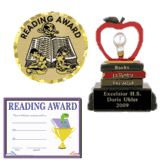
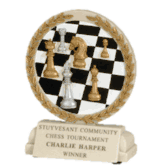
Strategic recognition transforms classroom culture. Unlike participation trophies that lose meaning, targeted awards for specific achievements build genuine pride and motivation. The key is recognizing diverse strengths - academic excellence, improvement, effort, kindness, creativity, and leadership.
Start with free printable award certificates that cost nothing but mean everything. Customize them for your classroom: "Math Multiplication Master," "Reading Rock Star," "Kindness Champion," "Problem Solver Extraordinaire." Print on colorful paper, add stickers or hand-drawn doodles, and watch students beam with pride. These certificates often end up on refrigerators for years!
Weekly classroom awards maintain motivation between report cards. "Student of the Week" is classic, but get creative: "Mistake Maker of the Week" (celebrating learning from errors), "Question Master" (best questions asked), "Helper Hero" (kindness to classmates). Display winners on a bulletin board "Hall of Fame" that rotates monthly.
Create achievement levels students work toward all year. Bronze level: mastering basics. Silver: consistent performance. Gold: helping others learn. Platinum: leadership and excellence. Visual progress charts with stickers or stamps show advancement. This gamification motivates without creating unhealthy competition.
Monthly recognition assemblies (even just 10 minutes) build anticipation. Award categories beyond academics: "Most Improved Handwriting," "Best Line Leader," "Cleanup Captain," "Positive Attitude Award." Every child should receive recognition at least once per quarter - track this carefully to ensure no one's overlooked.
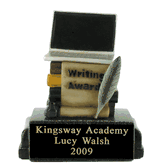
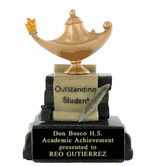
Consider ordering classroom achievement awards or student recognition medals for major milestones like reading goals, perfect attendance streaks, or year-end achievements. Physical awards they keep forever validate their hard work. Parents appreciate tangible recognition of their child's growth.
Peer recognition systems teach students to celebrate others' success. "Compliment Cards" where students write appreciation notes to classmates, "Shout Out Board" for public praise, or "Friday Appreciation Circle" where everyone shares something positive about someone else. This builds classroom community while teaching important social skills.
Technology Tools and Digital Resources
Technology should enhance, not replace, hands-on learning. Use digital tools strategically for maximum impact without screen zombification.
Apps That Actually Help
Seesaw creates digital portfolios where students document learning through photos, videos, and voice recordings. Parents see real-time progress without demanding constant updates.
Nearpod makes presentations interactive - students respond on devices while you maintain control. It's like having a teaching assistant who never calls in sick.
Epic! provides thousands of digital books with read-to-me options for struggling readers. It tracks reading time and interests, helping you recommend books they'll actually read.
YouTube Channels for Learning
Crash Course Kids explains complex concepts in bite-sized videos perfect for elementary attention spans. SciShow Kids answers those impossible questions like "Why do we have eyebrows?" NumberRock creates math music videos that will get stuck in everyone's head (including yours).
Technology Survival Tip: Always have a non-tech backup plan. The WiFi will fail during your most technology-dependent lesson. The interactive whiteboard will freeze during observations. Murphy's Law was written by a teacher, probably during state testing week.
Parent Communication and Involvement
Parents are partners, not problems (mostly). Effective communication prevents misunderstandings and creates home support for classroom learning.
Weekly Newsletter Wisdom
Send Friday folders with week recaps and upcoming previews. Include conversation starters: "Ask me about our science experiment with dancing raisins!" Parents appreciate knowing what to discuss besides "How was school?" (Fine.) "What did you learn?" (Nothing.)
Share celebration photos showing learning in action. Parents seeing their child engaged and happy prevents 90% of complaint emails. Plus, they'll share on social media, making you look amazing.
Volunteer Management
Channel parent energy productively. Create specific volunteer roles: Reading Helper, Math Game Leader, Art Project Assistant. Clear expectations prevent the parent who wants to teach their own curriculum or criticize your methods.
Mystery Readers program has parents surprise read to class. Kids love guessing whose parent will appear, and parents feel special without long-term commitment.
End-of-Year Activities and Celebrations
The last weeks of school require special activities to maintain sanity when everyone's brains have already started summer vacation.
Academic Year Reviews That Don't Bore
Create "Year in Review" videos where students film news reports about their learning. Have them write letters to next year's students with advice. Design class yearbooks with academic highlights rather than just photos.
Host curriculum carnival where students create game booths teaching concepts to younger grades. They'll review without realizing it, and younger students get excited about next year.
Transition Activities
Moving up ceremonies don't need to be boring. Create academic achievement showcases where students present favorite projects. Design "graduation" from one grade's skills to the next with specific accomplishments recognized.
Time capsules for students to open in middle school create closure while building excitement for the future. Include current work samples, goals, and predictions. Email their future teachers for delivery - they'll love the connection.
Summer Learning Prevention (of the Slide)
Send home summer learning calendars with one simple daily activity. Create reading passports for library visits. Design STEM challenges using household items. Make it fun, not homework, or it won't happen.
Share free resources like library summer programs, museum free days, and educational apps. Parents want to help but need direction that doesn't require teaching degrees.
Your Teaching Toolkit Essentials
Every teacher needs go-to activities for different situations. Build your collection gradually - trying to implement everything at once leads to teacher burnout and student confusion.
The Emergency Sub Plan
Create detailed sub plans including seating charts with photos (subs never believe the kid claiming to be someone else), bathroom procedures, and behavior management tricks. Include easy-win activities that review without introducing new concepts.
Leave "Sub Appreciation" notes from your class thanking them in advance. Subs will work harder for classes that appreciate them, and your students will behave better knowing you'll hear about it.
Assessment and Reflection
Keep running records of what works and what doesn't. That amazing lesson that flopped? Note why. The throwaway activity that engaged everyone? Document it. Your future self will thank you next year.
Student feedback matters. Ask what activities they loved, what helped them learn, what they'd change. They'll give honest insights you'd never consider, like how sitting on carpet squares instead of desks made poetry less scary.
June Reality Check: The last week of school will involve more movies than teaching, desks will be cleaned out to reveal artifacts from September, and at least one student will cry because school is ending (plot twist: it might be you). This is normal. You survived another year of elementary education - you're basically a superhero!
Creating Your Classroom Legacy
Years later, students won't remember every lesson, but they'll remember how your classroom felt. They'll remember the teacher who made learning fun, who celebrated their successes, who believed in them when they didn't believe in themselves.
Your activities and games aren't just time fillers - they're memory makers. The shy kid who found confidence through classroom presentations, the struggling reader who discovered joy in books, the class clown who learned to channel energy positively - these transformations happen through engaging, thoughtful activities.
Build traditions unique to your classroom. Maybe it's Friday dance parties, Wednesday word challenges, or Monday morning shares. These rituals create belonging and anticipation. Students will tell their siblings about your class, creating legacy and reputation.
Remember that perfection isn't the goal - connection is. Some days, survival is success. Some lessons will flop spectacularly. Some activities will devolve into chaos. That's okay. Tomorrow brings new opportunities to engage, inspire, and occasionally hide in the supply closet for thirty seconds of silence.
Teaching elementary school is simultaneously the most exhausting and rewarding job on the planet. You're shaping future adults, one brain break, educational game, and creative activity at a time. When May rolls around and you see how much they've grown, you'll understand why teachers return each August despite knowing exactly what awaits.
Embrace the beautiful chaos. Celebrate the small victories. Build your activity arsenal gradually. And remember - when all else fails, there's always silent reading time while you pretend to organize your desk but actually question all your life choices. Then a student will randomly hug you or finally understand that concept you've taught sixteen ways, and you'll remember why you became a teacher.
Welcome to elementary education - where every day is an adventure, lesson plans are merely suggestions, and somehow, miraculously, learning happens!